太阳辐射(光)是海洋生态系统的核心能量来源。有多少光能进入海洋,又能穿透多深,不仅决定了海洋生命过程的节律,更是海洋科学研究中必须精确量化的关键参数。海面的平静与汹涌,水体的湛蓝与浑浊,这些时间与空间上的动态变化,共同塑造了海洋中光的独特律动。
海洋水色遥感技术,正是通过解析太阳辐射(光)在大气和海洋的传输过程,利用水体颜色信息反演水体生物光学参数、浅海水深和底质特征等,从而实现对海洋初级生产力、生态系统状态、沿海和内陆水体水质等的长时序、大范围监测。同时,也为赤潮、浒苔、溢油等突发事件,及珊瑚礁、海草床等生态系统的实时监测提供了重要技术支撑。
余小龙博士从事海洋水色遥感机理与应用研究,致力于构建普适性水体生物光学参数遥感反演算法及提升海洋上层辐射传输模拟精度。基于在中国沿海、西北太平洋、北大西洋、青藏高原湖泊等全球多个代表性水域的实地观测数据,他在以下方面取得了系统性进展:
在遥感算法方面,围绕影响海洋辐射传输的关键生物光学参数,系统开展了遥感算法的研发与优化,显著提升了水体固有光学特性、漫衰减系数、叶绿素a浓度、悬浮颗粒物浓度、离水反照率及浅海底质等参数的反演算法精度与普适性,并纠正了长期以来关于离水反照率对海表反照率贡献可忽略的认识偏差;
在技术装备方面,针对国际上离水反照率原位测量设备的空白,主导完成了自主化设备从概念设计、组装调试到算法校正的全链条开发,为获取高质量的实测数据奠定了技术基础。
在数据融合方面,与团队共同提出了跨大气校正算法,为融合国产卫星、构建自主可控的长时序水色产品提供了技术支撑。同时,基于长时序水色卫星观测,首次揭示了赤道高叶绿素舌近20年向西扩张趋势,拓展了对海洋生态系统变化的科学认识。
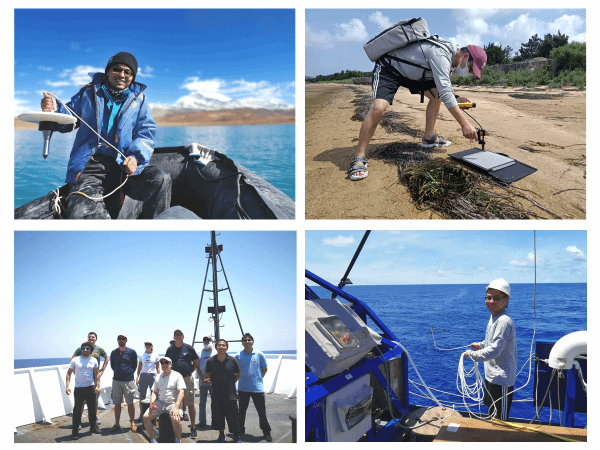
图 1. 余小龙博士参加现场观测航次部分照片。左上,第二次青藏高原综合科学考察(拉昂错,2021年5月);右上,山东荣成天鹅湖海草调查(2022年8月);左下,北大西洋VIIRS卫星Cal/Val航次(2018年5月);右下,西北太平洋Carbon-Fe夏季航次(2020年7月)。
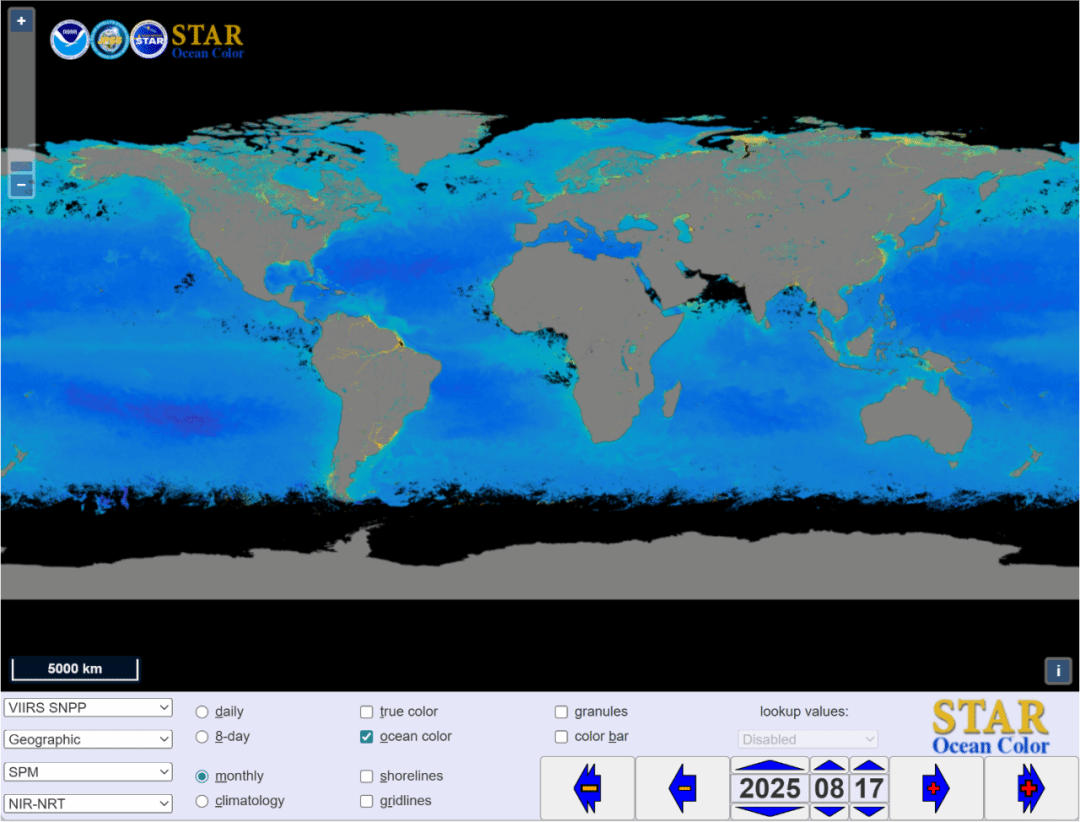
图 2. 余小龙博士研发的悬浮颗粒物浓度(SPM)遥感算法被美国NOAA采纳用于业务化产品发布。图为2025年8月全球水体月平均SPM空间分布图(来自NOAA OCview)。
余小龙博士目前研究涵盖以下四个方面:
1) 水体生物光学参数的长时序演变及其对气候变化的响应与反馈;
2) 上层海洋短波辐射传输参数化及其在海气耦合和气候模式中的应用;
3) 基于人工智能的生物光学参数、非光学活性水环境参数、浅海底质(珊瑚礁、海草)遥感反演;
4) 近海、大洋多源水色卫星产品高一致性时空融合技术。
如有兴趣了解余小龙博士的更多情况,欢迎访问其个人主页:https://mel2.xmu.edu.cn/faculty/XiaolongYu/,或联系xlyu@xmu.edu.cn。
人物名片:
余小龙博士本、硕、博分别毕业于同济大学、华东师范大学和荷兰特温特大学。2017年至2019年在美国麻省大学波士顿分校开展访问学者研究,2019年7月获批MEL杰出博士后,并于2024年1月入职厦门大学海洋与地球学院,2025年8月正式加盟海洋生物地球化学全国重点实验室。近五年在Nature Communications,Remote Sensing of Environment等知名SCI/EI期刊发表论文27篇(第一/通讯作者论文12篇),研究成果被国际水色协调小组作为亮点成果报道,研发算法被广泛引用,并支撑Nature Sustainability,Nature Geoscience等知名期刊论文成果。主持国家自然科学基金面上、青年科学基金(C类)项目、多个重点研发计划子课题及省市级项目课题等,作为核心骨干参与国家级项目近十项,担任Intelligent Marine Technology and Systems和《先进小卫星技术》青年编委,Remote Sensing和Sensors专题编辑。
Dr. Xiaolong Yu: Exploring the interplay of light and ocean
Solar radiation (light) is the fundamental energy source for marine ecosystems. The amount of light that penetrates the ocean and the depth to which it can reach not only governs the dynamics of marine life processes but also represents a critical scientific question that requires precise quantification in oceanographic research. The ocean surface is sometimes calm as a mirror, sometimes surging with waves; meanwhile, the open ocean appears deep blue, while estuarine waters are turbid and chaotic. These variations determine the patterns of light propagation within the ocean.
Satellite ocean color remote sensing analyzes the transfer of solar radiation through the atmosphere and ocean. By retrieving bio-optical parameters, shallow-water bathymetry, and benthic features from water color, it enables long-term, large-scale monitoring of primary productivity, ecosystem states, and water quality in inland, coastal and oceanic waters. At the same time, it provides vital real-time monitoring tools for events such as red tides and oil spills, as well as for coral reef and seagrass ecosystems.
Dr. Xiaolong Yu has long been engaged in research on the mechanisms and applications of ocean color remote sensing, with his current work centered on improving and optimizing the parameterization of shortwave solar radiation transfer across the air–sea interface and in the upper ocean. His earlier research was built upon extensive field surveys across diverse aquatic environments worldwide, generating valuable in situ datasets. Based on these observations, he has:
1) Developed and optimized remote sensing algorithms targeting key bio-optical parameters, significantly enhancing the retrieval accuracy and global applicability of inherent optical properties, diffuse attenuation coefficients, chlorophyll-a and suspended particulate concentrations, remote-sensing reflectance, and shallow-water substrates. With the developed algorithm, he corrected the long-standing misconception that the contribution of water-leaving albedo to sea-surface albedo and its spatiotemporal variability can be neglected.
2) Addressed the gap in field measurement of water-leaving albedo by designing, assembling, and testing self-developed instruments, along with data correction algorithms, to ensure the acquisition of high-quality observations.
3) Advanced multi-satellite data processing by proposing a cross-satellite atmospheric-correction scheme, providing a technical foundation for the integration of Chinese satellites and the generation of autonomous, consistent long-term ocean color products.
4) Building on these efforts, Dr. Yu has also initiated studies on the climate response of marine ecosystems using time-series ocean color observations. Notably, he was the first to reveal a westward expansion of the equatorial high-chlorophyll tongue over the past two decades, offering new insights into marine ecosystem variability.
Dr. Xiaolong Yu’s current research focuses:
1. Long-term evolution of bio-optical properties and their responses and feedbacks to climate change;
2. Parameterization of shortwave radiation transfer in the upper ocean and its applications in air–sea coupled and climate models;
3. Remote sensing retrieval of bio-optical properties, optically inactive aquatic environmental parameters, and shallow-water substrates (coral reefs, seagrass) based on artificial intelligence;
4. High-consistency data fusion of multi-source ocean color satellite products in coastal and open-ocean.
For more information about Dr. Yu, please visit his homepage: https://mel2.xmu.edu.cn/faculty/XiaolongYu/ or contact him at xlyu@xmu.edu.cn.
Biography:Dr. Xiaolong Yu received his B.Sc., M.Sc., and Ph.D. degrees from Tongji University, East China Normal University, and the University of Twente, the Netherlands, respectively. Since 2017, he worked at the University of Massachusetts Boston as visiting scholar, and in July 2019 he joined MEL as a postdoctoral researcher. He became a faculty member at the College of Ocean and Earth Sciences, Xiamen University, in January 2024 and officially rejoined MEL in August 2025. Over the past five years, he has published 12 SCI/EI papers as first or corresponding author in leading geoscience journals, including Nature Communications and Remote Sensing of Environment, with his research recognized by the International Ocean Colour Coordination Group as highlight achievements. He has led projects funded by the National Natural Science Foundation of China (General Program and Youth C Program), key R&D subprojects, and provincial/municipal programs, and has served as a core contributor to nearly ten national-level projects. He is currently a Young Editorial Board member for Intelligent Marine Technology and Systems and a guest editor for special issues in Remote Sensing and Sensors.