Abstract
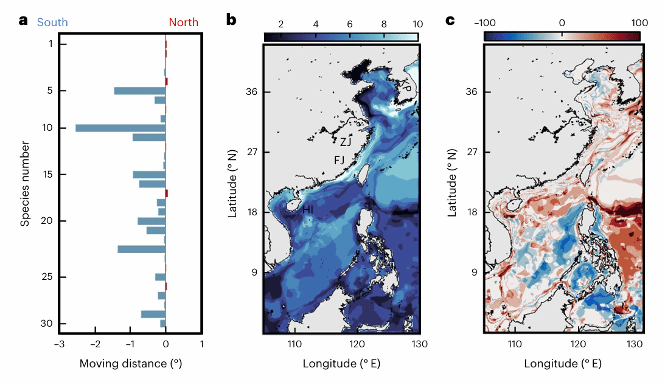
Salinity shapes ocean circulation and marine biogeography, yet its long-term spatiotemporal variability and ecological impacts in marginal seas remain poorly constrained. We reconstruct a high-resolution sea surface salinity dataset (2000–2020) for the China Seas using a machine learning framework that integrates in situ cruises and buoys with satellite observations and diagnose drivers with an eigen microstates approach. The El Niño/Southern Oscillation (ENSO) is the dominant control, modulating evaporation–precipitation, river discharge and Kuroshio intrusion. During El Niño, sea surface salinity increases by up to 25% in ocean-dominated regions but decreases up to 21% in river-dominated zones, amplifying meridional salinity contrasts. Species-distribution models indicate a southward habitat shift up to 2.5° latitude for 90% of key fish species. Under projected ENSO intensification, salinity inhomogeneity and associated ecological impacts are likely to strengthen. These results support an ‘ENSO forcing–salinity–fishery’ positive feedback framework and call for integrating salinity dynamics into adaptive, climate-informed fisheries management.
Wang, Z., Huang, H., Wang, G. et al. ENSO shapes salinity regimes and fish migration in the China Seas. Nat. Clim. Chang. (2026).
https://doi.org/10.1038/s41558-026-02559-3