Abstract
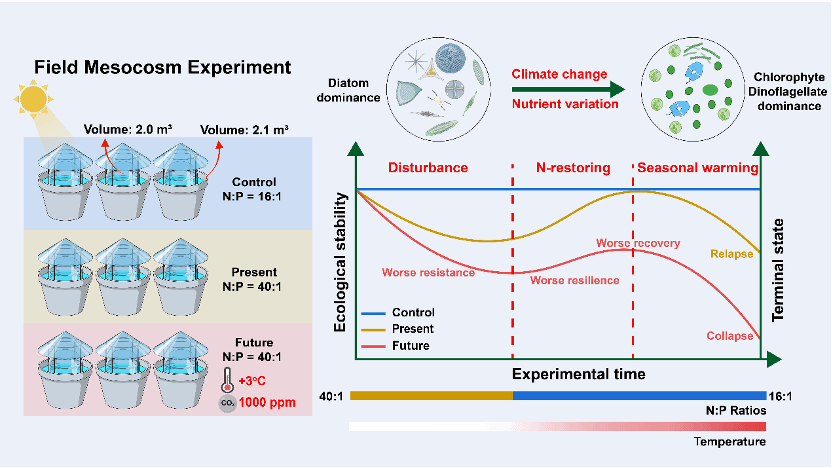
Anthropogenic activities are driving elevated N:P ratios in coastal waters and climate change. However, the ecological stability of plankton ecosystems under these combined stressors remains poorly understood. Using 32-day mesocosm experiments, we evaluated how subtropical plankton ecosystems respond to elevated N:P ratios (40:1) under present (20°C, 440 ppm CO2) and future (23°C, 1000 ppm CO2) scenarios in the first half period, followed by the next half period of restoration to Redfield ratio (16:1). A control group maintained a N:P ratio of 16:1 throughout the experiment. Elevated N:P stimulated phytoplankton biomass and primary productivity, with more pronounced effects observed under the future climate scenario. After 5-day nutrient restructuring, phytoplankton biomass and primary productivity returned to the control levels. However, a rapid rebound was detected after day 23, particularly under the future scenario. Relative to the present scenario, ecological stability (resistance, resilience, and recovery) of phytoplankton biomass and primary productivity declined in the future scenario. Furthermore, nutrient restructuring led to a marked shift from diatom- to dinoflagellate and chlorophyte-dominated assemblages, which was more significant in the future scenario. Elevated N:P ratios also enhanced grazing rates of zooplankton, with stronger effects in the future scenario, though grazing rates returned to control levels following nutrient restoration. Elevated N:P did not affect elemental stoichiometry immediately but enhanced POC:POP and PON:POP by the end of the experiment, particularly in the future scenario. Our findings highlight that mitigating nitrogen inputs alone may be insufficient to restore coastal ecosystems; climate change would increase the challenges of coastal restoration due to nutrient restructuring.
Chen, J., Xiong, Y., Ge, J., Zhao, X., Feng, Y., Li, X., Song, C., Yang, X., Zhang, R., Yang T. J., Zhang, W., Sun, S., Zhang, C., Xue, H., Wang, D., Gao, K. & Gao, G*. (2026). Responses of ecological stability in subtropical coastal phytoplankton communities to varying N:P ratios under present and future scenarios. Water Research, 293, 125438.
https://doi.org/10.1016/j.watres.2026.125438