Abstract
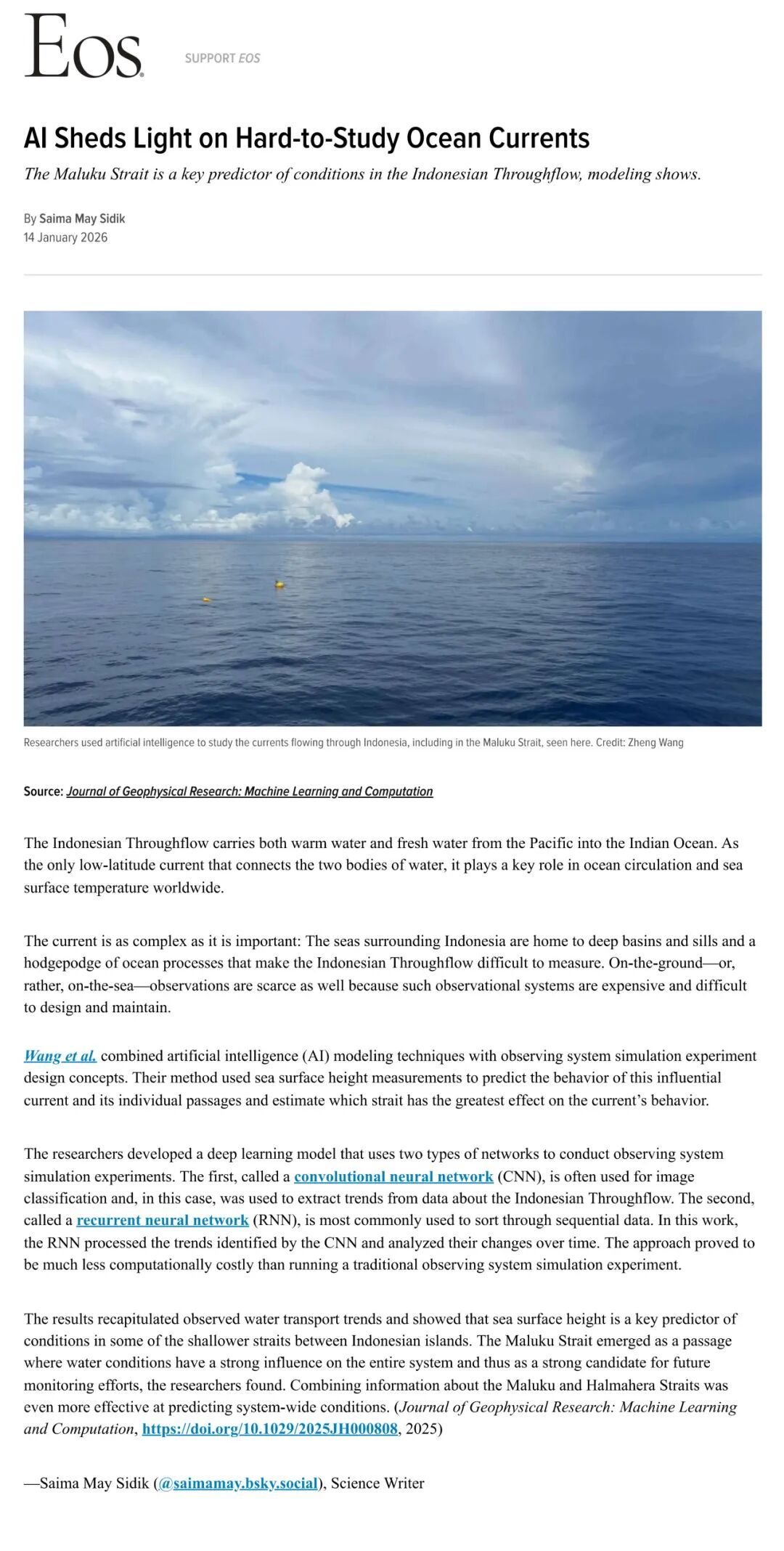
The Indonesian throughflow (ITF) is a key component of the ocean thermohaline circulation, crucial for transporting heat and materials in the global ocean. Due to the complex hydrodynamic conditions and current patterns in the Indonesian Seas, accurate predictions of the ITF face multiple challenges, including the lack of long-term, simultaneous observations across various straits. In this study, we establish a deep learning system capable of conducting observing system simulation experiments (OSSEs), which is applied to the Indo-Pacific confluence region for reconstructing transport through multiple passages using the sea surface height. We examine (a) to what degree known sea level variations can determine the main inflows and outflows through the Indonesian Seas and (b) which strait is most critical to determining ITF variability. The approach is validated using model simulations and reanalysis data. Our results indicate that an improved convolutional neural network combined with a recurrent neural network model effectively represents the temporal variations of throughflows across the Indonesian Seas. The prediction skills can be significantly improved if aided by transport time series from a small number of passages. Overall, OSSEs suggest that a better realization of transport variability in the Maluku Strait could benefit the comprehensive assessment of the ITF.
Wang, Z, Wang, Y, Xue, H (2025). Deep Learning Models and Observing System Simulation Experiments of the Indonesian Throughflow. Journal of Geophysical Research: Machine Learning and Computation. doi:10.1029/2025JH000808
https://doi.org/10.1029/2025JH000808