Abstract
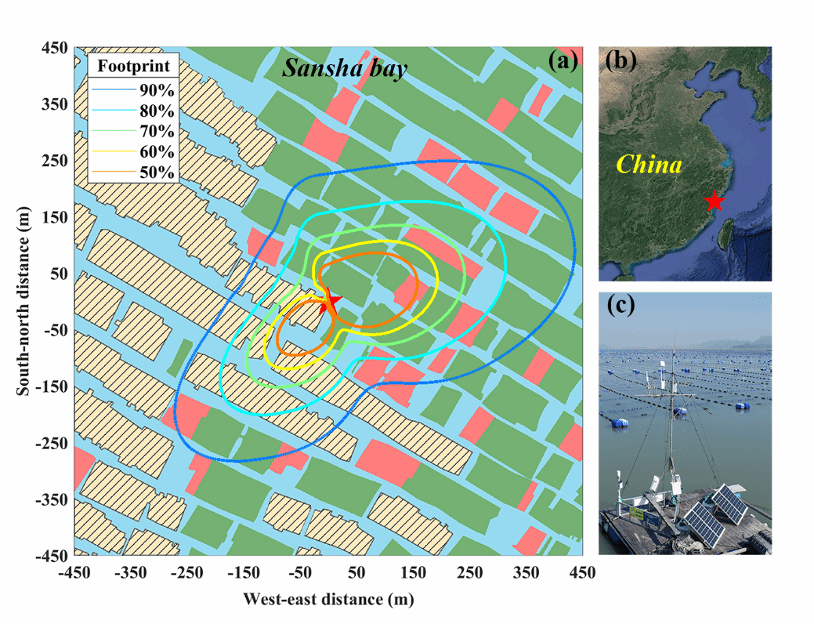
Macroalgae aquaculture ecosystems have been increasingly recognized as coastal biogeochemical hotspots of air–sea net ecosystem carbon dioxide (CO2) exchange; however, their roles in regulating the temporal variability of net ecosystem methane (CH4) exchange (NME) receive little attention mainly due to very limited data availability. Here, we applied the eddy covariance (EC) technique to acquire 1-yr (June 2023 to May 2024) NME measurements, over a subtropical macroalgae aquaculture ecosystem in southeast China, to examine the temporal variability of NME across time scales and its contribution to net radiative forcing. The results indicated that (a) this ecosystem acted as a CH4 source in most months with the summer accounting for about two-thirds of annual NME of 0.40 g C m−2 yr−1; (b) the inclusion of annual NME increased the sustained-flux global warming potentials (SGWPs) by 11.0% from 219.3 (CO2 only) to 243.4 g CO2-eq. m−2 yr−1 for a 100-yr time horizon; (c) NME and its radiative contribution varied across seasons, farming periods, and growth stages, with the temporal fluctuations mainly controlled by temperature and tidal activities; (d) bimodal varying patterns across tidal levels were identified with larger fluxes occurring when tidal level changed most rapidly. This is the first EC study to confirm that CH4 emission intensifies the warming effect of CO2 efflux from macroalgae aquaculture ecosystems. The observed strong temporal variability of CH4 and CO2 fluxes and their asynchrony highlight the importance of high-frequency and continuous flux measurements in accurately assessing their net radiative forcing at both short- and long-term scales.
Deng, Y., X. Guo, D. Hu, H. Luo, Y. Chen, and X. Zhu* (2025). Methane emission intensifies the warming effect of carbon dioxide efflux from a subtropical coastal macroalgae aquaculture ecosystem. Limnology and Oceanography. doi: 10.1002/lno.70293
https://doi.org/10.1002/lno.70293