Abstract
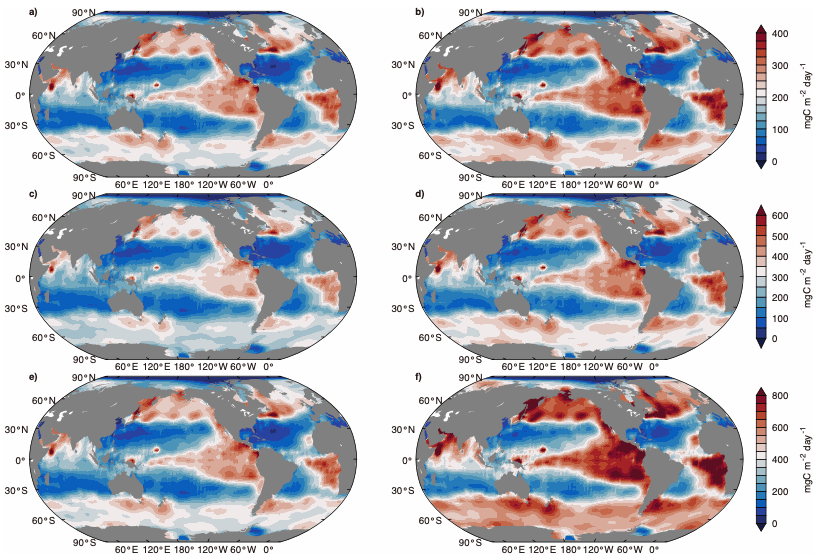
The biological carbon pump (BCP) transfers CO2 from the surface ocean to depth, helping regulate atmospheric CO2 and accounting for roughly one-third of glacial–interglacial CO2 changes. Its strength is widely estimated from satellite-based relationships between net primary production (NPP) and export efficiency, but these approaches cannot distinguish organic matter rapidly recycled near the surface from that exported to depth. This ambiguity inflates export estimates and obscures BCP variability. Here, using a tracer-constrained inverse biogeochemical model, we explicitly quantify the “rapid recycling” fraction of NPP that does not contribute to deep-ocean sequestration. We find that ∼48%–60% of satellite-measured NPP is respired within the euphotic zone within hours to days, leaving a climatological mean carbon export of 13.72–15.55 Pg C yr−1—consistent across multiple satellite NPP products. Export fluxes derived from our inverse model agree more closely with sediment trap and 234Th observations than those from empirical NPP–export relationships or Earth system models. Of course, the inverse model's steady-state assumption and dependence on a low-resolution climatological circulation field prevent future predictions and limit its accuracy in coastal and polar regions. These results still show that deep-ocean tracer constraints yield robust BCP estimates despite large surface productivity uncertainties, and they provide the first global-scale quantification of rapid surface recycling as a major limitation of satellite-based export assessments.
Y.-C. Wu, F.W. Primeau, Z. Lee, M. Dai, and W.-L. Wang, Surface Recycling Versus Deep Export: Insights from Tracer‐Constrained Inverse Modeling of the Biological Carbon Pump, Journal of Geophysical Research: Oceans, 130, e2025JC023021.
https://doi.org/10.1029/2025JC023021