Abstract
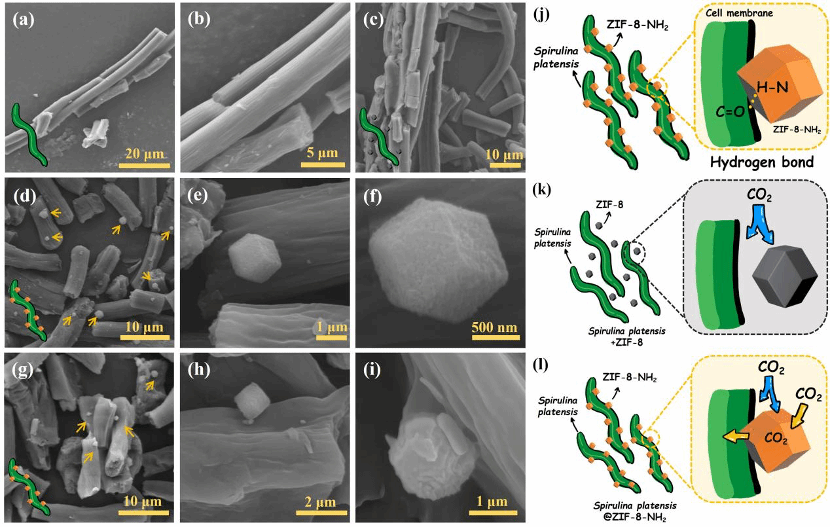
Excess anthropogenic carbon dioxide (CO2) emissions are a major driver of the ongoing climate crisis, underscoring the urgent need for scalable CO2 removal technologies Photosynthesis enhancement via microalgae represents a promising pathway. Here, we report a targeted CO2 removal strategy using a metal-organic framework (MOF), ZIF-8-NH2, assembled directly onto the surface of Spirulina platensis. Synthesized through a mixed-ligand route, the water-stable ZIF-8-NH2 exhibits primary amine functionality that promotes hydrogen bonding with microalgal membrane proteins, enabling stable self-assembly as confirmed by spectroscopic and microscopic analyses. At an optimal concentration of 50 ppm, ZIF-8-NH2 increased dry cell weight and CO2 fixation rate by 149% and 93%, respectively, relative to unmodified controls, whereas free ZIF-8 impaired growth. In bicarbonate-rich media, the enhancement in biomass was reduced to 25%, suggesting that the assembled MOF functions as an artificial CO2-concentrating mechanism. These findings establish a promising platform for enhancing microalgal carbon capture and offer new insights into cell-surface MOF applications.
Rong, Y., Chen, J., Zhang, M., Wu, T., Jiang, Y., Lin, X. and Dai, M.*, 2025. Self-assembled metal organic frameworks enhance carbon fixation in Spirulina. Communication Material 6, 259 (2025).
https://doi.org/10.1038/s43246-025-00991-0